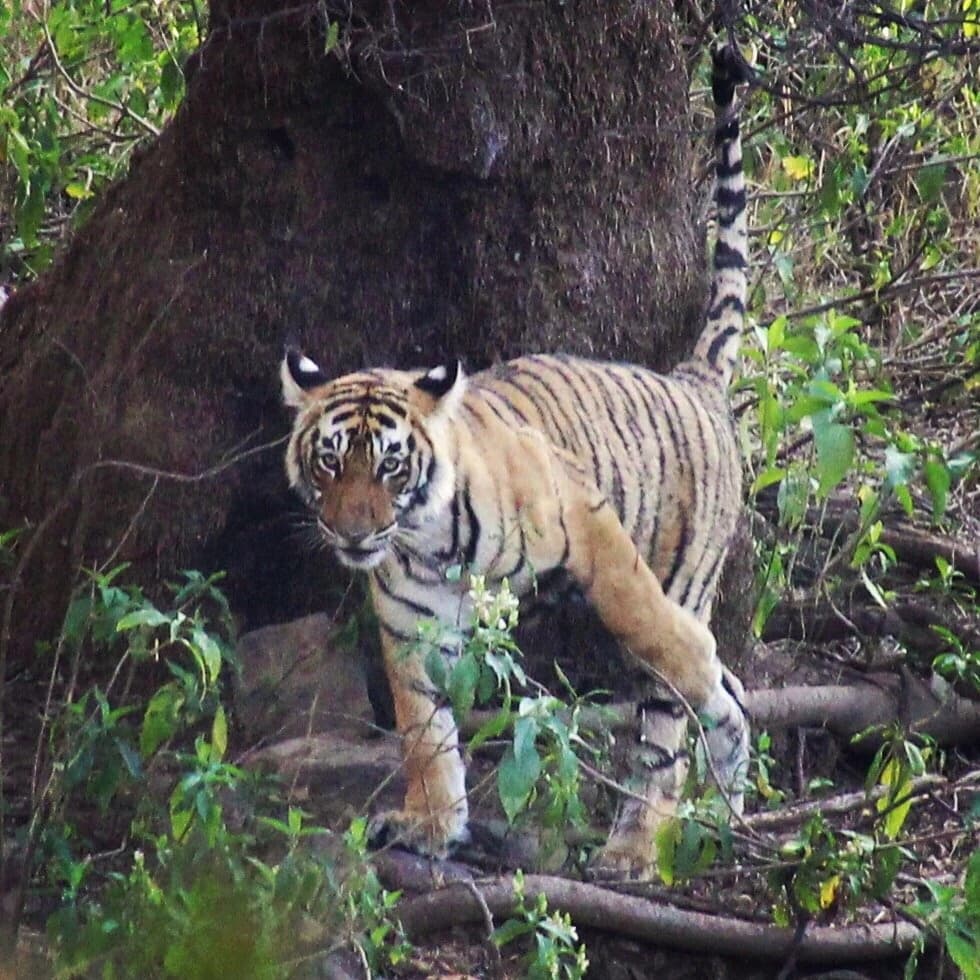
We sell a safari day in exactly three places: Ranthambore, Sariska and the Chambal river at Dholpur. Bandhavgarh, Kanha, Corbett, Tadoba and Pench are not on any of our routes, and here is why that matters.
Most articles about tiger safaris in India list the same six or seven national parks. This one lists three, because three is how many our trips actually visit. If the tiger is the whole point of your holiday, skip to the section headed "The famous tiger parks we do not go to" — it tells you to book a different company, and that is the useful answer.
The three places we actually run a safari
Across our fifteen India itineraries, big-cat and river wildlife appears in exactly three places:
- Ranthambore in eastern Rajasthan, on five tours
- Sariska, between Delhi and Jaipur, on one tour
- The Chambal river at Dholpur, on that same tour
That is the complete list. Everything else below is context for deciding whether it is enough for you.
Ranthambore: what a full safari day really means
Ranthambore sits beside the town of Sawai Madhopur, about four hours by road from Jaipur and reachable as an extension of the Golden Triangle. It has dry deciduous forest, three lakes, and a tenth-century fort standing above the whole thing. Tigers here are used to vehicles, which is why sightings happen at all.
A full safari day on our itineraries means two drives: one leaving your hotel before dawn, one in the afternoon. Both are shared. This is the part most brochures leave vague, so here it is plainly: the park allocates the vehicle, not us. Depending on availability on the day you travel, you will be in a jeep carrying up to six people or in an open canter — a safari bus carrying up to twenty. You cannot book a private drive, and neither can we. Every other part of your trip is private and guided; the drive into the park is the one part that is not.
Zones are also allocated by the park authority. Some zones produce more sightings than others in a given season, and nobody selling you the trip controls which one you get.
Tours that include this full Ranthambore day:
- Rajasthan – The Land of Kings, 14 days from EUR 1,800, with two nights at Ranthambore
- On the Trails of the Maharajas, 15 days from EUR 1,840
- India from North to South, 14 days from EUR 1,840
- Royal Rajasthan & Varanasi, 14 days from EUR 1,520
- The Magic of Rajasthan, 10 days from EUR 1,000
Two of those are worth singling out. Royal Rajasthan & Varanasi also stops at the Keoladeo Ghana bird sanctuary near Bharatpur, where you go round by cycle rickshaw rather than by jeep — more than 360 bird species, and the easiest wildlife day on any of our India routes for anyone who dislikes rough tracks. India from North to South continues to Kerala and adds the Periyar lake boat.
Sariska, and the Chambal boat at Dholpur
The Magic of Rajasthan is the only itinerary that carries all three wildlife stops, and at 10 days from EUR 1,000 it is also the shortest and cheapest India trip we sell.
At Sariska the itinerary includes one shared jeep safari (up to six people) in the late afternoon. Sariska is savannah and open woodland rather than dense jungle. Tigers were reintroduced here after the population was wiped out in 2004, and numbers remain low — leopard, sambar and nilgai are the realistic sightings, and a tiger is a genuine piece of luck rather than an expectation.
At Dholpur you take a boat on the Chambal, water level permitting. That caveat is in the itinerary for a reason: in a dry year the trip cannot run. When it does, the Chambal is the strongest wildlife hour of the whole tour. It holds gharial — the narrow-snouted fish-eating crocodile — plus Gangetic river dolphin, freshwater turtles and a long list of waterbirds. Almost no tour groups come here. You stay at the Raj Niwas Palace, a heritage hotel in the former royal residence.
The famous tiger parks we do not go to
Bandhavgarh, Kanha, Jim Corbett, Tadoba and Pench are the parks with India's highest tiger densities and the ones serious wildlife photographers book. We do not run a trip to any of them. They are not in a single one of our thirty-one itineraries, and we will not put one together for you as a bolt-on — building a good wildlife trip means knowing which zone, which lodge and which naturalist, and we do not have that knowledge for central India.
If the tiger is the reason you are travelling — if you want four days of drives in one park, a private vehicle, a specialist naturalist and a lodge chosen for its gate access — book a dedicated wildlife operator. You will get a better trip than we can sell you, at a price that reflects it.
What we do well is a cultural journey through Rajasthan, the Golden Triangle or the south, with a wildlife day inside it. If that is the trip you want, Ranthambore is a good day. If you want a wildlife holiday, it is not one.
When to go, and when the parks close
The core zones at Ranthambore and Sariska close for the monsoon, roughly from the start of July to the end of September. Exact dates are set by the forest department each year and can shift by a fortnight either way. We do not sell a Ranthambore safari day inside that window.
Two useful seasons remain, and they are good for opposite reasons.
March to June gives the best chance of a sighting. Water dries up, animals concentrate around the remaining lakes and waterholes, and the vegetation thins out so you can see further. It also gets brutally hot: 40–45°C in May and early June in eastern Rajasthan, and an open canter has no air conditioning. Morning drives are manageable; afternoon drives in May are hard work.
October to February is the comfortable season. Daytime temperatures around 22–28°C, cold mornings that need a fleece and a hat for a 6am drive, thicker cover and animals less tied to water. Sightings are less frequent. This is also when Rajasthan is at its best for everything that is not a safari, which is why most of our itineraries run then.
For the wider picture, see our month-by-month guide to the best time to visit India.
Big cats and river wildlife elsewhere in our catalogue
India is not the only place we have wildlife, and in some cases the alternatives are better value.
- Periyar, Kerala — a boat trip on Periyar Lake from Thekkady, water level permitting, plus a walk along the park boundary and the spice plantations above it. Elephant, sambar and birdlife; tigers exist but are effectively never seen. On South India – Exotic World (11 days from EUR 1,570), The Diversity of South India (25 days from EUR 2,860) and India from North to South.
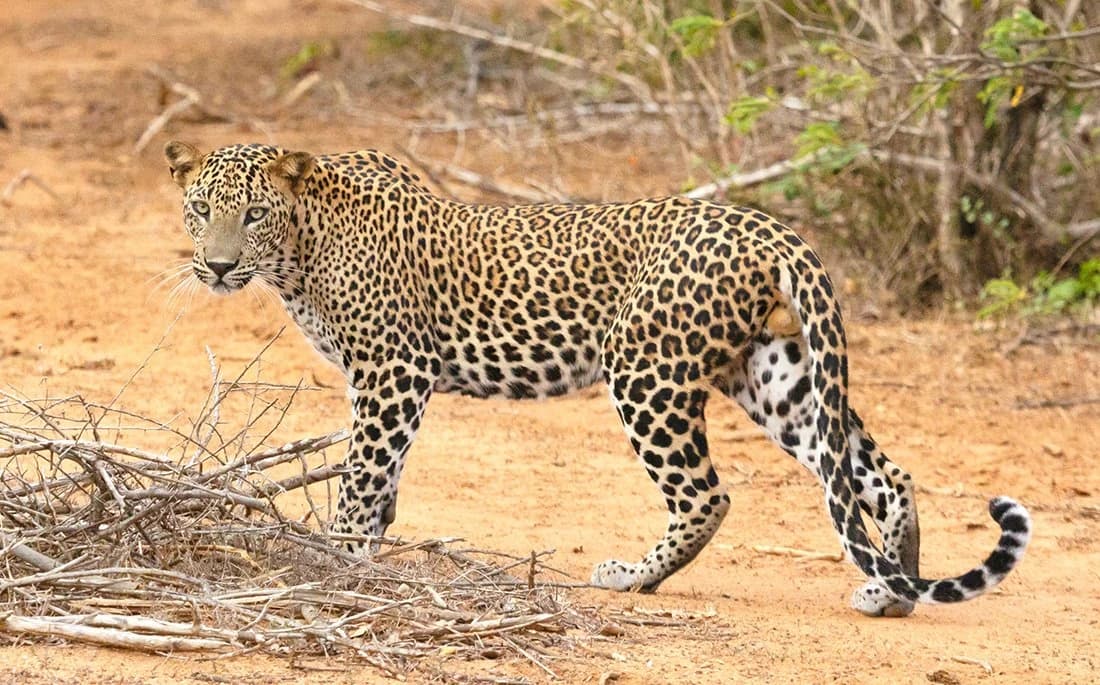
- Yala and Udawalawe, Sri Lanka — Udawalawe is the most reliable elephant viewing in any country we sell, Yala has the densest leopard population in the world. On Sri Lanka's Glory (14 days from EUR 1,050), Culture & Nature (14 days from EUR 1,120), Breathtaking Nature & Culture (14 days from EUR 1,220) and Between Culture and Jungle (14 days from EUR 1,380).
- Chitwan, Nepal — two or three days of jeep safari, canoe trips, nature walks and birdwatching in the Terai lowlands. One-horned rhino is the animal you come for. On Temples, Shrines & Himalayas (14 days from EUR 1,350), Trekking Tour through Nepal (11 days from EUR 1,575) and Culture and Himalayan Hiking (14 days from EUR 1,760). Note that jeep safaris do not run in Chitwan during July, August and September.
Every trip tagged with a wildlife day is listed on our wildlife tours page.
What a sighting is actually worth
No sighting is guaranteed anywhere, by anyone. Two drives at Ranthambore give you a fair chance and no more than that. People who see a tiger remember the day for the rest of their lives; people who do not have still spent a morning watching sambar, langur, crocodile, peacock and a hundred bird species in good light, which is not a bad morning.
The single thing that changes your odds most is the number of drives, not the price of the hotel. If you want more than two, tell us at the enquiry stage and we will build an extra night at Sawai Madhopur into the itinerary. That is a real option and it costs less than most people expect.
Practical points
- Book early for March and for the Christmas and New Year period — vehicle permits at Ranthambore sell out weeks ahead.
- Morning drives beat afternoon drives for animal activity in almost every month.
- Wear neutral colours, and bring a fleece between November and February. The pre-dawn drive to the gate is genuinely cold.
- Binoculars matter more than a long lens for most people.
- Your German-speaking guide, hotel accommodation, breakfast, 24-hour contact and a bottle of water on arrival are included on every tour we run. International flights are not; any domestic flight written into the itinerary is.
Tell us which weeks you have and whether the safari day is a highlight or a nice-to-have, and we will build the trip around the honest answer.