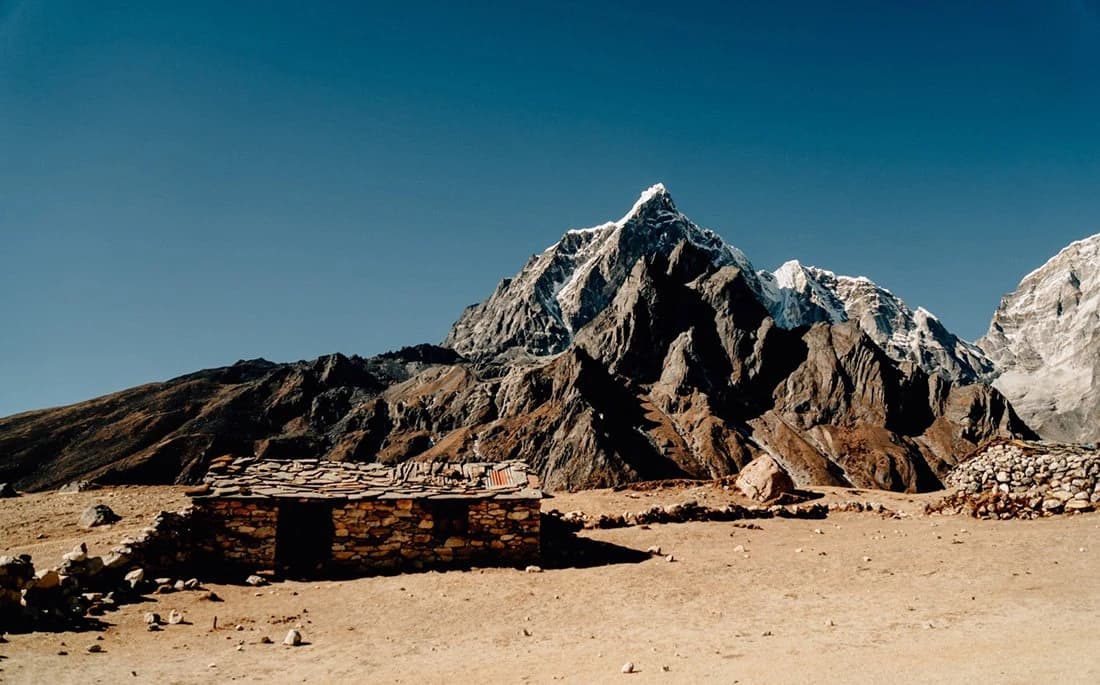
Three royal cities, two great stupas, one ridge with a view of Everest on the horizon. What the Kathmandu valley holds, what the 2015 earthquake took, and how many days each of our six Nepal tours spends here.
Nepal's mountains are why most people book. The Kathmandu valley is where the trip starts, where it ends, and on our six Nepal itineraries it takes up anywhere from a day and a half to six days. It is worth knowing what you get.
The valley is a bowl roughly 25 km across at about 1,400 m, holding three cities that were three separate kingdoms until 1769: Kathmandu, Patan and Bhaktapur. Each built its own royal square, its own temples, its own craft trade. They are 6 and 13 km apart, and they do not look the same.
Three Durbar Squares, and how they differ
"Durbar Square" just means palace square. Seeing one is not seeing the other two, and every one of our Nepal trips visits at least two.
- Kathmandu Durbar Square is the busiest and the least intact. It holds the Hanuman Dhoka palace complex, the Taleju and Jagannath temples, the Kal Bhairav statue, and Kasthamandap — the wooden rest house said to be built from a single tree, which gave the city its name. Traffic runs along two sides of it. You will not get a quiet photograph here.
- Patan Durbar Square is the smallest and, for most people, the best. It is one dense line of stone and brick facing the palace: the Krishna Mandir carved entirely in stone, the Golden Temple (Hiranya Varna Mahavihar) a few streets away, the Mahabuddha temple whose every brick carries a Buddha image. Patan is still a metalworking city; the workshops are a short walk from the square.
- Bhaktapur Durbar Square is the quietest, because Bhaktapur charges entry to the whole old town and keeps most vehicles out. The Fifty-Five Window Palace, the five-storey Nyatapola temple, and Pottery Square where the wheels are still turning. If you only have one clear morning in the valley, spend it here.
Swayambhunath and Boudhanath
Swayambhunath sits on a hill west of the city, reached by a stairway of about 365 steps (there is a road to a side entrance if the stairs are a problem). It is the oldest stupa in the valley and the best free view over the whole bowl. The monkeys are real and they take food out of hands.
Boudhanath is the opposite: flat, enormous, and circled all day by Tibetan and Sherpa pilgrims walking clockwise. It is the centre of Tibetan Buddhist life in Nepal, ringed by monasteries and rooftop cafés. Go late afternoon, when the butter lamps are lit and the crowd on the kora is thickest. Both appear on every one of our Nepal itineraries, and both sit on the spiritual side of what we run rather than the mountain side.
Pashupatinath, and what you can actually see
Pashupatinath, on the Bagmati river, is the most important Shiva temple in Nepal. Non-Hindus cannot enter the main temple — this is not negotiable and no guide can get you in. What you can do is stand on the terraces on the east bank and watch the cremation ghats and the daily rituals across the water.
Be honest with yourself about whether you want that. Cremations happen in the open, a few metres away, with families present. Our guides will explain what is happening and will not push you closer than you want to go. Some travellers find it the most valuable hour of the trip; others would rather spend the morning in Patan.
What the 2015 earthquake took, and what has come back
The 25 April 2015 earthquake, magnitude 7.8, hit the valley hard. Eleven years on, the picture is mixed and the guidebooks you read before you fly are probably out of date.
Rebuilt and standing again: Boudhanath, whose spire was dismantled and reconstructed, reconsecrated in late 2016 — it looks, now, as though nothing happened. Kasthamandap in Kathmandu Durbar Square collapsed completely and was rebuilt with traditional joinery over seven years. Patan's Char Narayan temple, which fell entirely, is back in place.
Still visibly unfinished: parts of the Hanuman Dhoka palace complex, where restoration of the upper towers has run for years. Bhaktapur lost the Vatsala Durga temple and several smaller shrines, and some plinths in that square still stand empty. Nyatapola, which survived both 1934 and 2015 without structural damage, did not move.
Expect scaffolding somewhere. It does not spoil the visit, but nobody should arrive thinking the valley was put back exactly as it was.
Nagarkot: Everest on the horizon, not underfoot
Nagarkot is a ridge village at 2,175 m on the eastern rim, about two hours from Kathmandu. People go for one reason: sunrise. On a clear morning the Himalayan wall runs across the whole northern horizon, and in good conditions the Everest massif is visible at the far eastern end of it.
Be clear about what that means. It is a view from roughly 170 km away — a serrated line catching first light, not a mountain looming over you. From our own itineraries the peaks you are most likely to pick out are Dorje Lhakpa and Shishapangma, which are much closer. No tour we sell treks to Everest Base Camp. If Base Camp is the trip you want, we are not the right operator and we would rather tell you now.
Clear mornings are not guaranteed either. October to early December gives the best odds; by March the pre-monsoon haze has usually built and the far peaks disappear even on dry days.
Four of our six Nepal trips include Nagarkot. Trekking tour through Nepal drives there straight from the airport, stopping at Bhaktapur en route. Impressions of Nepal and Majestic Himalayas both walk in, from the Changu Narayan temple at 1,540 m — the oldest Hindu temple in the country — along about two hours of easy unpaved track to Telkot, and give you a second day hiking the villages below the ridge.
How much valley time each trip gives you
All six Nepal tours pass through the valley. They are private and guided, with a German-speaking guide, hotels, breakfast, 24-hour contact and a bottle of water on arrival included. International flights are not.
- Impressions of Nepal — culture and nature, 17 days, from EUR 1,640 — the most valley time in the catalogue: six days before you leave for Pokhara, covering all three cities, both stupas, Pashupatinath, Nagarkot and Dhulikhel.
- Majestic Himalayas, 17 days, from EUR 1,640 — the same valley run minus the Dhulikhel day, so five days, then eleven trekking stages to Annapurna Base Camp at 4,130 m. The hardest trip we sell in Nepal.
- Culture and Himalayan hiking, 14 days, from EUR 1,760 — two full sightseeing days covering Kathmandu, Patan and Bhaktapur, then straight to Chitwan and the hills.
- Temples, shrines and Himalayas, 14 days, from EUR 1,350 — three valley days plus a day at the Naydo monastery in Pharping. No Nagarkot on this one; its sunrise morning is at Sarangkot above Pokhara instead.
- Trekking tour through Nepal, 11 days, from EUR 1,575 — the fastest pass through. Bhaktapur and Nagarkot on arrival day, one full Kathmandu day, then out.
- The world of Nepal, 9 days, from EUR 930 — the only Nepal trip with no trekking at all. If you want the culture without walking stages, this is the one.
Every trip is built for you, so valley time can be added. Tell us at the enquiry stage and we will put the extra day where it is worth having, which is usually Bhaktapur.
When to go
October and November are the best weeks of the year here: days around 23-25°C in Kathmandu, clear skies, and the Dashain and Tihar festivals falling somewhere in that window. December and January stay clear but get cold — daytime highs near 18°C, nights close to freezing at Nagarkot's altitude, and few valley hotels have proper heating. February to April warms up to 28°C with rhododendron in flower, but the haze thickens and the far mountains fade. June to September is monsoon: warm, green, wet in the afternoons, and Nagarkot is often inside the cloud rather than above it.
Our month-by-month guide to Nepal has the detail, including how the trekking seasons line up.
Places in the valley we do not run
Kirtipur, Namo Buddha and the sleeping Vishnu at Budhanilkantha are all worth a half day, and none of them appears on any of our six itineraries. We would rather say so than list them as though we sold them. If one of those matters to you, ask when you enquire — a private trip can absorb a half day.
Practical notes
Kathmandu's air is poor in the dry months; a lot of travellers wear a mask in traffic. Crossing the valley takes longer than the map suggests, so a Patan morning and a Bhaktapur afternoon in one day is a bad plan and we do not build it that way. Thamel, the backpacker quarter, is where the trekking shops and bookshops are and is walkable in an evening. Eat dal bhat at least once; it comes with refills.
Many people pair the valley with more than Nepal. Our guides to an India and Nepal trip and a Nepal and Bhutan trip cover how those combinations work in practice, and the full Nepal destination page lists every route we run. If you are sorting by length rather than theme, most of these fall under 10-14 days, and the valley itself is squarely cultural travel.