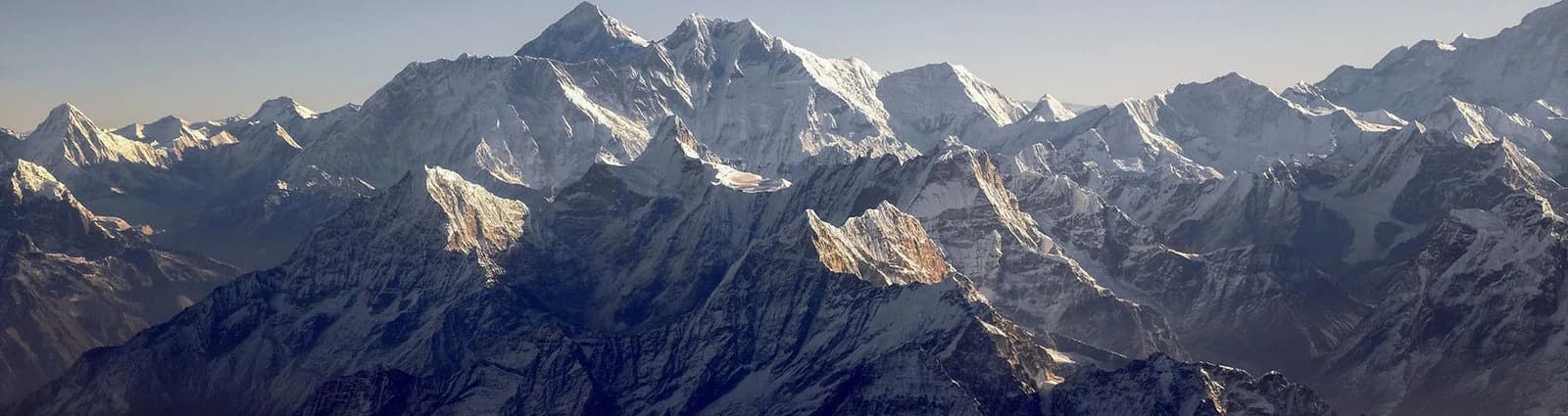
October and November give Nepal its clearest air; March and April bring the rhododendrons. Here is what each month actually costs you in the valley, at Pokhara, in Chitwan and on the trail.
Nepal has two seasons that work and two that need planning around. Autumn is the first choice. Spring is the second. Winter and the monsoon are not written off, but they change what a trip can deliver.
The short answer
- October and November — the clearest air of the year, dry trails, everything open. The best window if the mountains are the point.
- March and April — rhododendrons in flower above Pokhara, milder nights on the trail, noticeably more haze.
- December to February — cold at altitude, dry and often very clear, and the strongest months for the jungle. Hard on the high trekking stages.
- June to mid-September — the monsoon. Kathmandu still works. The mountains and the jungle largely do not.
Every trip we run in Nepal is private and built around your own dates, so the real question is not when Nepal is open. It is what your month costs you.
October and November: the clearest air of the year
The monsoon usually breaks in the last week of September, and what follows is why autumn fills up first. The rain has washed the dust and moisture out of the air, and the Annapurna and Dhaulagiri walls are visible from Sarangkot at 1,592 m on most mornings rather than a lucky few.
Kathmandu sits at about 1,400 m. October days run near 25°C and nights near 13°C. By late November it is roughly 22°C by day and 7°C at night. On the walking routes it is colder than the numbers in town suggest: Ghorepani at 2,850 m is close to freezing overnight in November, and the pre-dawn climb to Poon Hill at 3,210 m is below it. Lodges up there have a stove in the dining room and nothing in the bedrooms.
Two things to plan for. Autumn is the busiest season on the Annapurna trails, so lodge space goes early — and on the Annapurna Base Camp route several nights are in shared rooms in any month, because conservation rules cap the beds that high up. Dashain and Tihar also fall in this window; more below.
March and April: rhododendrons, and haze
Spring is the other window that works. March in Kathmandu runs about 25°C by day and 9°C at night; April is closer to 28°C. Nights on the trek are milder than in autumn, which matters if you are not confident about cold.
The specific draw is the forest. The rhododendron and oak stretches around Ghorepani and Tadapani flower from late March into April, and four of our six Nepal routes walk straight through them.
The trade-off is visibility. Pre-monsoon dust and field burning build through April, and the long-distance views soften. The mountains are usually there at first light and gone by mid-morning. If a clear Annapurna panorama is the thing you are travelling for, autumn beats spring.
One route-specific note: on the Annapurna Base Camp trek, the last stretch up to Deurali is a rough track after winter landslides.
May: hot low down, hazy up high
Kathmandu reaches around 30°C in May. Chitwan, at about 150 m in the Terai, sits in the high thirties and can touch 40°C. Trails are quieter than in April, but haze is at its worst before the rains arrive. May is workable for temples and villages, poor for panoramas.
June to September: the monsoon
Roughly four-fifths of Nepal's annual rain falls in these months. Pokhara is the wettest sizeable town in the country and takes more than 800 mm in July alone. Rain comes in heavy bursts rather than all day, but the consequences are real: landslides close sections of the Kathmandu–Pokhara highway, cloud sits on the ridge lines for days, and leeches are constant on forest trails.
Our own itineraries carry one hard seasonal rule, and it is worth reading before you pick dates: Chitwan National Park runs no jeep safaris in July, August and September. Any trip pairing the jungle with the mountains gets planned around that, and the canoe trips and other jungle activities are weather-dependent all year.
There is one honest exception to the monsoon rule. The rain-shadow districts north of the main range — Upper Mustang, Dolpo — stay dry while the rest of the country is under cloud, and summer is their season. We do not run trips there, so that is information rather than an offer.
December to February: cold at altitude, good in the lowlands
Winter is underrated for everything below about 2,000 m and unforgiving above it.
Kathmandu runs around 18°C by day and 2 to 3°C at night in January. Many hotels have no central heating, so pack for indoors as well as out. Valley and Terai mornings often start under fog that clears by mid-morning; the afternoons that follow are frequently the clearest of the year.
This is the strongest season for Chitwan. It is dry, the days are mild, and the tall elephant grass is cut back in January, which opens up sightlines across the grassland. Rhinos are the animal our itineraries name; a Bengal tiger is possible rather than likely, in any month, and no day note promises one.
Above 2,500 m, winter is a different trip. Snow can close the higher stages of the Poon Hill route, and Annapurna Base Camp at 4,130 m carries real avalanche and snow risk in January and February. We would not build that route for those months.
What each month does to each part of a Nepal trip
- Kathmandu Valley — works all year. Durbar Squares, Swayambhunath, Boudhanath and Bhaktapur are city sightseeing; rain or cold changes comfort, not access. Winter mornings are foggy, June to August humid and wet.
- Pokhara and the Annapurna foothills — driven entirely by visibility. October and November first, March second. Sarangkot, Poon Hill and the Shanti Stupa all depend on clear weather, which is why our day notes describe the viewpoint rather than promise the view.
- Chitwan — October to March. No jeep safaris in July, August or September.
None of our Nepal routes uses a domestic flight. You drive the roughly 200 km between Kathmandu and Pokhara — six to eight hours, and several itineraries break it at Bandipur or Dhulikhel. So the winter fog that delays flights out of Kathmandu matters far less here than it would elsewhere.
Festivals worth knowing about
Dashain falls in late September or October and runs about fifteen days. Offices and many shops close for several of them, and Nepalis travel home in numbers, so roads and buses are full. Tihar follows two to three weeks later, with oil lamps and marigolds across Kathmandu. Neither is a reason to stay away. Both are a reason to fix dates early.
In February or March, Losar brings Tibetan New Year to Boudhanath — one of the better reasons to be in Kathmandu in winter.
If you are also weighing Bhutan, it runs on the same two windows: October to November, and March to April.
What we actually run in Nepal
Six private, guided trips, all of them flying into Kathmandu and out of it, from EUR 930 for the nine-day route to EUR 1,760 for the fourteen-day culture and hiking itinerary. Four include a multi-day walk above Pokhara; four take in Chitwan, for one to three nights depending on the route. See them all on the Nepal page or across our tours.
Four things to be straight about. There are no scheduled group departures — every trip is private, on your dates. None of these six itineraries goes into the Khumbu or to Everest Base Camp; every multi-day trek we sell in Nepal is in the Annapurna region above Pokhara, over Poon Hill on four trips and on to Annapurna Base Camp on one. There is no five-star tier — hotels run Standard, Deluxe, Superior and Executive. And international flights are not included, though the airport meet-and-greet, the transfer, hotels and breakfast are. Five of the six list a German-speaking guide in the price; Majestic Himalayas, the route that continues to Annapurna Base Camp, does not, so ask before booking if the language matters on that one.
Tell us the window you have and what you want from it — the view, the walk, the jungle — and we will say plainly whether your month delivers it.