December to April is the dry season, and February and March are the best of it. Here is what each month actually delivers — rain, sea temperature, snorkelling visibility, price — and what we honestly sell.
December to April is the dry season. February and March are the best of it: least rain, calmest sea, clearest water for snorkelling. They are also among the most expensive weeks of the year, and that is not a coincidence.
May to November is the wet season. It is cheaper and it is not a write-off, but you will get rain.
One thing to say early, because it changes how you should read the rest. We sell the Maldives as a four-night beach finish to an India or Sri Lanka trip. Three tours touch it. No itinerary includes an overwater villa. If the villa on stilts is the whole point of your holiday, this is not the right page and we are not the right operator.
The two monsoons, in plain words
The Maldives runs on two wind seasons, and Maldivians name them.
Iruvai, the northeast monsoon, roughly December to April. Wind off the northeast, drier air, calmer water, more sun.
Hulhangu, the southwest monsoon, roughly May to November. Wind off the southwest, heavier rain, choppier sea, more cloud.
The change is not a switch. December is wetter than its dry-season label suggests and usually dries out as the month goes on. May is the changeover, and one of the wettest months of the year.
What does not change is the heat. Daytime highs sit at 29–31°C in every month. Nights fall to about 25–26°C. Humidity stays between 75 and 85% all year. What varies is not heat but rain, wind and how clear the water is.
Month by month
- January — Dry season proper, around eight hours of sun a day. Rain arrives as short heavy showers rather than grey afternoons. Busy and expensive until the New Year rush clears.
- February — The driest month, typically well under 100 mm across the whole month. Flattest sea, best visibility. The month we would pick.
- March — Almost as dry, slightly warmer, still excellent underwater. Prices stay high.
- April — The hottest month. Sea temperature can reach 30°C. Still mostly dry, but humidity climbs and afternoon build-ups start. Rates ease late in the month.
- May — The turn, with squalls and real wind. Prices drop hard.
- June to August — Rain most days, usually in bursts rather than all day. Cloudier, choppier, cheaper. July and August tick back up on European school holidays.
- September and October — Wet, and among the greyest months. The cheapest weeks of the year sit in here.
- November — Still wet, but the wind starts to swing. Late November can be much better than early November.
- December — Improves through the month. The first three weeks are genuinely variable. From about 20 December, rates jump to their annual peak and many resorts add a compulsory gala dinner at Christmas and New Year.
Water temperature and snorkelling visibility
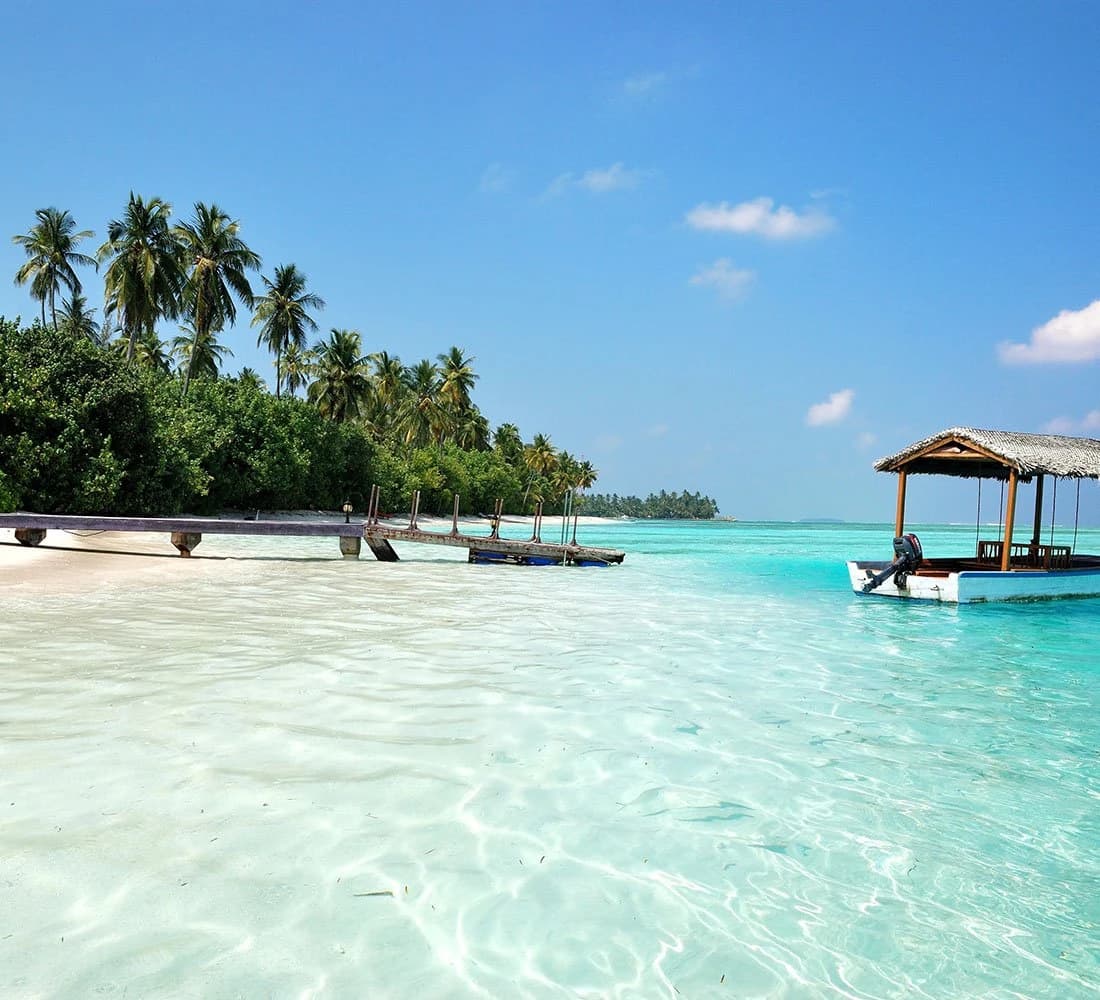
The sea sits between 27°C and 30°C all year. Coolest in January and February at around 27–28°C, warmest in April and May at close to 30°C. You will not need a wetsuit. Pack a rash guard for sun, not cold.
Visibility is the real seasonal difference: 20–30 metres in the dry months, dropping to 10–20 when plankton and wind stir the water.
That plankton is why the wet season has a following. It draws manta rays, and Hanifaru Bay in Baa Atoll fills up from May to November, peaking August to November. Note the geography before you plan around it: Baa Atoll is north of Malé and we do not sell it. The one island we name sits in South Malé Atoll. If Hanifaru is what you are after, book it separately — it is not what our beach finish gives you.
One more honest note on April. Very warm water in strong El Niño years has caused coral bleaching here before, notably in 1998 and 2016. Reefs recover, but a reef you snorkel in a bleaching year will not look like the brochure.
What the seasons cost
- Peak — roughly 20 December to 5 January. Highest rates of the year, plus those mandatory festive dinners.
- High — January through March, sometimes into April.
- Shoulder — late April into May, and late October into November.
- Low — May to September. Commonly 30–40% below peak for the same room.
Low season is still not budget travel — just a better ratio of money to sunshine than late December.
What we actually sell here
Three tours touch the Maldives, all private and guided, all giving four nights.
Paradise island Maldives is a five-day travel component from EUR 700 — met at Malé airport, speedboat to the island, four nights, and that is the whole product. It is built to bolt onto the end of an India trip.
India's facets & Maldives is 15 days from EUR 3,140 — Delhi, Agra, Jaipur, Jodhpur, Udaipur and Mumbai, then a speedboat from Malé to four nights in a Superior Beach Bungalow at Embudu Village, South Malé Atoll. A beach bungalow. Not a water villa. On departure day the transfer is by speedboat or seaplane depending on your flight time, and seaplanes only fly in daylight.
Breathtaking nature & culture is a 14-day Sri Lanka trip from EUR 1,220. The Maldives finish is optional: Colombo to Malé, then four nights at a resort you pick, priced on top by category, taking the trip to 17 days.
Two things to budget for. Both finishes need an international hop — Mumbai to Malé on the India trip, Colombo to Malé on the Sri Lanka one — and international flights are not included in our prices. And our room tiers run Standard, Deluxe, Superior and Executive: there is no five-star tier in the catalogue, and no fixed group departures. A German-speaking guide is included throughout. The full tour list and the Maldives destination page have the rest.
If you are adding the Maldives to India
North India works October to March. Delhi, Agra and Rajasthan are pleasant in that window and punishing outside it — April onwards regularly passes 40°C before the monsoon arrives.
The Maldives dry season is December to April. The overlap is December through March. February and March are the pick for the 15-day trip: Rajasthan comfortable, the Maldives at its clearest.
For the wider picture, our month-by-month guide to India covers the regional differences, and the India destination page has the tours.
If you are adding the Maldives to Sri Lanka
This is harder, and we would rather say so. Sri Lanka has two monsoons of its own, and the route crosses both coasts: Dambulla, Sigiriya, Pasikuda on the east coast, then Kandy, Nuwara Eliya, Yala and Galle in the south.
The south and west coasts are dry from December to March. The east coast is dry from May to September. Yala is at its best February to July, and Block 1 usually closes for maintenance from around September to mid-October.
So no month is perfect. February and March are the best compromise: Galle and Yala at their best, the hill country manageable, and the Maldives in its dry season. Pasikuda in February is past the worst of its rain without being at its own peak. July and August flip the picture — the east coast is good, the south coast and the Maldives are both wet.
Ramadan, and a note about Malé
The Maldives is a Muslim country. Resort islands run normally through Ramadan and are where alcohol is served. On Malé and the inhabited local islands, daytime cafés close during the fasting month, dress is modest year-round, and swimwear belongs on designated bikini beaches only.
Ramadan moves about eleven days earlier each year; in 2027 it runs across February and early March. Worth knowing if you plan a night in Malé rather than transferring straight out.
So, pick a month
February or March if you want the best of the water and can pay for it. December or January if the school calendar decides for you, in which case book early. June to September if price matters more than the forecast and you can live with rain.
Four nights on a beach at the end of a proper trip through India or Sri Lanka is exactly what these itineraries are built for.