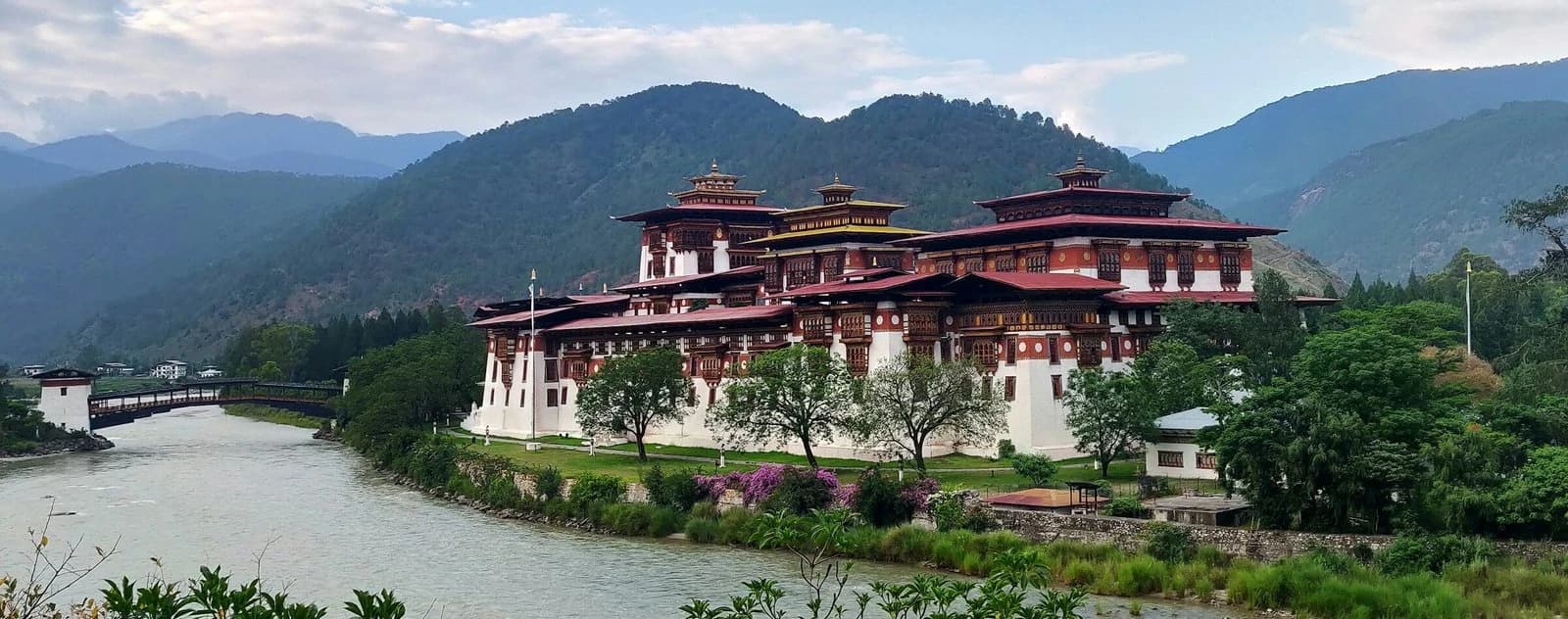
Two windows work: late March to May for rhododendrons on the passes, and late September to November for clear skies and tsechus. Includes where our three Bhutan trips do not fit the month you had in mind.
Bhutan has two good windows: late March to May and late September to November. Spring puts rhododendrons on the high passes. Autumn gives the clearest mountain air of the year and the main festival season. Everything outside those months is a trade-off, and one or two of those trade-offs are worth making.
First, what we actually sell. We run three trips to Bhutan — six to eight days each, all private, all guided. They work the western corridor of Paro, Thimphu and Punakha, with one adding the Haa valley. We do not sell central Bhutan, Bumthang or the Phobjikha valley. So this guide covers when those three trips work best, and says plainly where a month suits Bhutan but not us.
The short answer, by month
- March to May — the strongest all-round choice. Warm days, rhododendrons above 3,000 metres, and the Paro Tshechu usually falls here.
- June to August — monsoon. Quiet and green, but cloud hides the mountains and Paro flights get delayed.
- Late September to November — the clearest skies of the year and the main festival season. Also the busiest.
- December to February — cold, dry and very clear. Fewest visitors. Snow can close the high passes.
Spring: late March to May
March starts cold and ends warm. Thimphu sits at 2,320 metres, so expect roughly 17°C by day and 2°C at night in March, about 20°C and 5°C in April, and 23°C and 10°C in May. Punakha is only around 1,250 metres and behaves like a different country: 28°C days in April, 30°C by May.
The reason to come in spring is the flowering. Bhutan has more than forty rhododendron species, opening from late March at lower elevations through May higher up. The best of it in our catalogue sits on The magic of the gigantic Himalayas, our 8-day trip. Day six crosses the Chelela Pass at 3,988 metres, then walks about three hours downhill to the Keeli Nunnery at 3,600 metres. In April and early May that descent goes straight through the bloom.
The catch is May. Pre-monsoon showers start and haze builds over the valleys. The flowers are still there. The mountain views are already going.
The monsoon: June to August
Most of Bhutan's rain falls between June and September. Thimphu takes around 350mm in July alone. It usually rains in the afternoon and overnight rather than all day, so you can still travel — but you will see cloud where the Himalaya should be, and forest trails get leeches.
The bigger problem is getting in. Paro is Bhutan's only international airport, it sits in a narrow valley, and pilots fly the approach visually in daylight. Poor visibility means delays and cancellations, and losing a day out of a six-day trip is a large fraction of the trip. If you travel in monsoon, build a spare night into your flights.
One reason to come anyway: the Haa Summer Festival, two days in July, built around yak-herding culture, food and traditional archery. The magic of the gigantic Himalayas already overnights in Haa, so it is the one trip of ours that can be dated to it. That is a scheduling question, not a different itinerary — ask us.
Autumn: late September to November
This is when Bhutan looks the way people picture it. The rain stops, the air clears, and the peaks along the Dochula Pass at 3,080 metres come out properly. All three of our trips cross Dochula, twice each. In October you actually see what the pass is for.
Thimphu runs about 19°C by day and 7°C at night in October, dropping to 16°C and around 1°C by late November. Punakha stays near 26°C. Paro nights get close to freezing in November — pack a real jacket, not a fleece.
Two warnings. Hotel stock in Bhutan is limited and autumn fills early, so October dates need settling months ahead. And prices across the country are firmest in this window.
The tsechu festivals, and how to catch one
Tsechus are masked religious dance festivals held in dzong courtyards. Dates follow the Bhutanese lunar calendar, so they shift every year — nobody can give you a fixed date eighteen months out.
The three that sit on our routes:
- Paro Tshechu — spring, usually late March or April, five days at the Rinpung Dzong, which two of our three trips already visit. On the final morning a giant appliqué thangka is unfurled before dawn.
- Thimphu Tshechu — usually September, three days in the Tashichhoedzong courtyard.
- Punakha Drubchen and Tshechu — February or March at the Punakha Dzong. The Drubchen re-enacts the 17th-century fight against Tibetan forces.
Here is the honest part. None of our three itineraries lists a festival day as an included item. What they do is put you in Paro, Thimphu and Punakha, which is where all three festivals happen. Because every trip we run is private and built to your dates, catching a tsechu is a matter of setting the departure once the year's dates are published — not of buying a different product. Tell us at enquiry stage and we will work backwards from the festival.
Winter: December to February
Cold, dry, empty and very clear. Thimphu manages about 12°C by day in January and drops to -3°C at night; Paro nights go lower. Punakha barely notices winter — 17°C days, 5°C nights, which is why Bhutan's court used to move there for the cold months.
Winter suits The land of happiness, our 6-day trip. There is no trekking on it and no Chelela crossing, and the Tiger's Nest is offered either as a one-hour walk to the viewpoint or a two-hour climb to the monastery itself at 3,000 metres. Days are short and the upper path can be icy, so bring boots with grip.
Winter suits the other two less. Heavy snow can close the Chelela Pass, and The Kingdom of the Thunder Dragon includes a night in camp at around 3,800 metres below the Bumdra Monastery. That is a hard night in January. And Dochula sits on all three routes: after heavy snowfall it can shut for a day or two whichever trip you pick.
Matching the month to the trip
- The land of happiness — 6 days, from EUR 2,160. Thimphu, Punakha, Paro. The lowest ceiling of the three, and the Tiger's Nest climb is optional. Works year-round.
- The magic of the gigantic Himalayas — 8 days, from EUR 2,010. Adds the Haa valley, the Chelela Pass at 3,988 metres and the full three-to-four-hour climb to the Tiger's Nest. Best April to May for the flowers, October for the views.
- The Kingdom of the Thunder Dragon — 8 days, from EUR 2,500. A four-hour hike from Sang Choekor at 2,800 metres up to a camp at 3,800 metres, then down to the Tiger's Nest the next day. This is the highest of the three on foot, and the only one with a night under canvas. April, May and October.
All three include a German-speaking guide, hotel accommodation and breakfast. International flights are not included. Ask what sits inside your quote and what does not — Bhutan also charges a Sustainable Development Fee of USD 100 per person per night, held at that rate until at least 31 August 2027, plus a one-off USD 40 visa fee.
Two practical things worth knowing
Only Drukair and Bhutan Airlines fly into Paro, and there are no direct flights from Europe. All three of our itineraries route via Delhi. If you route yourself in from Kathmandu instead, sit on the right-hand side on a clear morning — the approach runs past Everest, Makalu and Kanchenjunga.
And because every trip is private, a Bhutan week can sit alongside a longer India or Nepal itinerary rather than standing on its own, which is how most people justify the flight time. If you are timing an India leg around the same trip, our month-by-month India guide covers a country with a very different calendar.
Ready to pick a month? See the three Bhutan itineraries and tell us your dates.