October and November give the clearest Kanchenjunga views. Spring brings the first tea. The monsoon hides the mountain.
The best time to visit Darjeeling is October and November. The monsoon has just washed the air clean, the days are mild, and Kanchenjunga is out on most mornings. March to May is the second window: warmer, greener, with the first tea of the year, but hazier views. June to September is the monsoon, and the mountain spends most of it hidden in cloud.
The short answer
- October to November: the clearest views of the year and the autumn tea harvest. Our first pick.
- Early December: still clear and dry, with cold nights.
- Late December to February: cold, often very clear, quiet tea gardens. Fog in the plains can delay flights in.
- March to May: spring flowers and the first and second tea flushes. Pleasant days, softer views.
- June to September: monsoon. Heavy rain, cloud on the ridges and slow mountain roads.
Why timing matters more here than almost anywhere
Darjeeling sits on a ridge at 2,134 metres, facing Kanchenjunga, the third-highest mountain on earth. That view is why most people make the trip. The town itself is charming, but the mountain is the main event, and it only shows itself when the cloud lifts.
The classic way to see it is from Tiger Hill, 13 km from town, before sunrise. On a clear morning you watch the whole range turn gold, with Everest a small point far off on the horizon. On a cloudy morning you see grey. The season decides which one you get far more than luck does.
October and November: clear air and autumn tea
By October the monsoon has pulled back. Weeks of rain have cleared the dust and moisture from the air, and the long views return. Days are mild and nights are cool, so a warm layer for the pre-dawn trip to Tiger Hill is enough.
This is also autumn flush season. Tea picked now has a deeper colour and a rounder, fuller taste than the spring teas. The gardens are green and active.
One thing to plan around: Darjeeling is a favourite holiday spot for Indian families, and the Durga Puja holidays in late September or October bring big crowds up from Kolkata. November is calmer, and the views hold up just as well.
Winter: December to February
Early December still behaves like November. After that it gets properly cold. Nights drop close to freezing in January, so pack real warm clothes.
The reward is the air. Winter skies are often very clear, and the mountain views can be excellent. The tea gardens are resting, so there is no fresh picking to see.
The practical catch sits in the plains, not the hills. From about the third week of December, dense morning fog settles over Delhi and regularly delays domestic flights. Our route reaches Darjeeling by flying from Delhi to Bagdogra, so a winter trip needs slack built around that flight.
Spring: March to May
Spring is the second good window. Rhododendrons flower on the higher slopes, the gardens wake up, and days in May run around 15 to 20°C. That makes Darjeeling a welcome escape when the plains below are at 40°C and more.
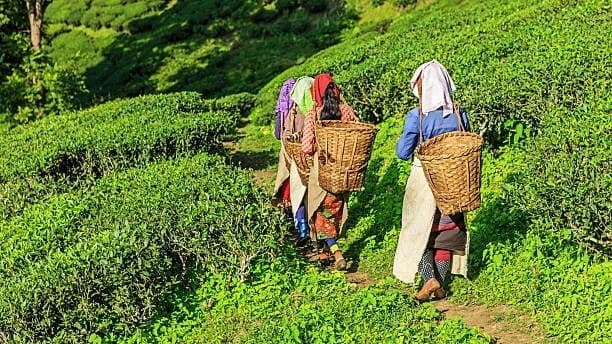
Spring is also when the most prized Darjeeling tea is made. The first flush starts in March: light, floral and expensive. The second flush follows in May and June, with the stronger muscatel taste many tea drinkers know the name for.
The trade-off is visibility. Haze builds through April and May. The mountain is often there at dawn and gone by mid-morning. If the Kanchenjunga view is the reason you are going, autumn beats spring.
Monsoon: June to September
The southwest monsoon reaches the eastern Himalaya in June. Early June can still work. By the third week, cloud usually sits on the ridges, and the sunrise at Tiger Hill becomes a lottery. July and August are the wettest months.
Rain on these steep slopes also means landslides. They can close sections of the hill roads, and the drive up from Bagdogra already takes several hours on winding roads. The tea keeps growing, and the monsoon flush is picked in large volume, mostly for blends. For a visitor, though, this is the one season we would steer you away from.
Darjeeling tea flushes at a glance
- First flush: March to April. Light, floral, the most sought after.
- Second flush: May to June. Fuller, with the famous muscatel note.
- Monsoon flush: July to September. Plentiful and strong, mostly used in blends.
- Autumn flush: October to November. Darker, rounder and mellow.
An honest note: our Darjeeling itinerary does not include a tea estate visit. The gardens surround the town and line the roads, but if tasting tea is a main reason for your trip, mention it when you send a request.
How our Darjeeling trip fits the calendar
Only one of our tours goes to Darjeeling: Colourful Rajasthan & Himalayas, 12 days from EUR 1,910. It starts in Delhi, visits the painted havelis of Shekhawati, then Jaipur and Agra, with the Taj Mahal before sunrise. On day 8 you fly from Delhi to Bagdogra and drive up to Kalimpong for a night, with its plant nurseries and a Buddhist monastery.
In Darjeeling the route covers the early drive to Tiger Hill, the narrow-gauge railway to Ghoom and its monastery, and a city tour. That tour includes the Himalayan Mountaineering Institute, founded by Tenzing Norgay, and the Padmaja Naidu Zoo. Both are closed on Thursdays, so the day order sometimes shifts. You then fly back to Delhi.
Because the trip combines the plains and the hills, it needs a month that suits both. Rajasthan is at its best from October to March. Darjeeling is best from October to early December, and again from March to May. The overlap is October, November and early March. November is the sweet spot: comfortable in Jaipur and Agra, clear in the hills, and before the December fog. For more on the plains side, see the best time to visit Rajasthan, or India month by month for the whole country.
If the Himalaya is the main reason for your trip, compare the best time to visit Nepal, which runs on a similar calendar. To go to Darjeeling with us, the place to start is Colourful Rajasthan & Himalayas. Send us a request with your dates and we will tell you honestly how the views and the weather should look.