
India's holiest city
Things to do in Varanasi: ghats, boats and the Ganges at dawn
The essential things to do in Varanasi are the evening aarti ceremony on the ghats, a boat on the Ganges at sunrise and a half day in Sarnath, where the Buddha gave his first sermon. Then walk the ghats and get lost in the old lanes. Two full days is the right amount. Both of our tours that go here spend two nights and include all three essentials.
Watch the evening aarti
Every evening at dusk, young priests on the riverbank perform the aarti, a fire ritual for the Ganges. They move large brass lamps in slow circles, in time with bells and chanting. Thousands watch from the steps and from boats on the water. The main ceremony is at Dashashwamedh Ghat.
Both of our Varanasi tours take you there by rickshaw on the first evening. Watching from a boat gives you a front-row view without the crush on the steps.
Take a boat on the Ganges at sunrise
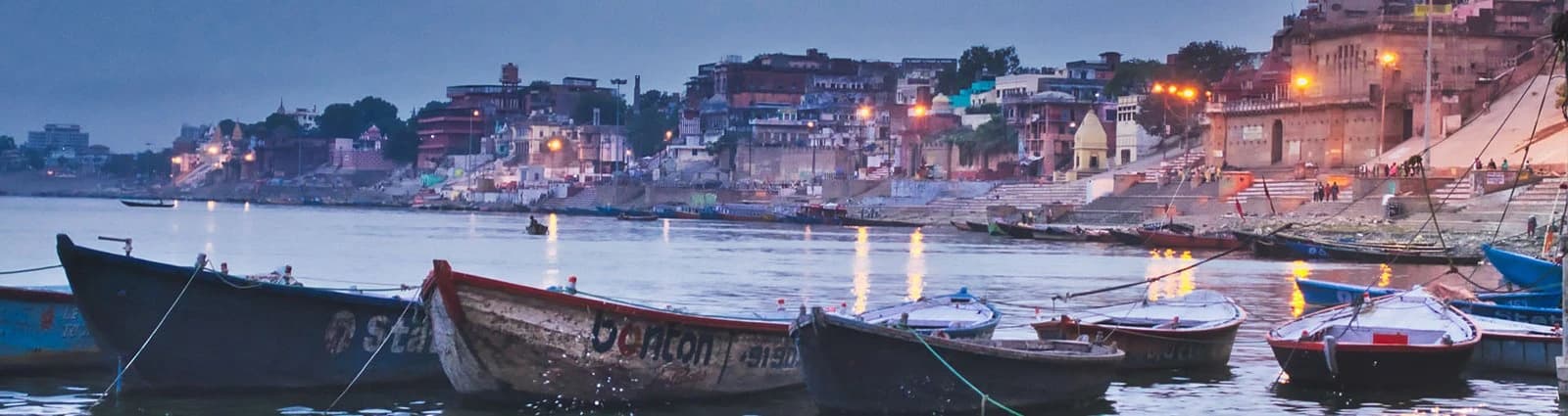
At first light the ghats come alive. Pilgrims bathe and pray, washermen beat clothes on stones, and smoke rises from the cremation grounds. From a boat you see it all along the river, quietly and at a respectful distance.
This is the moment most people remember. It is included on both tours, but depends on the water level. After heavy monsoon rain, boats may not run.
Visit Sarnath
Sarnath, about 10 km from the city, is where the Buddha gave his first sermon after his enlightenment. The large Dhamek Stupa marks the spot, among the ruins of old monasteries. The site museum holds the lion capital of Emperor Ashoka, now India's national emblem.
The site is calm and green, a good contrast to the old city. Both tours include the trip. The museum is usually closed on Fridays.
Walk the ghats
Dozens of ghats, stone steps down to the river, line the west bank. Each has its own temples and character. Walking from one to the next is one of the simplest and best things to do here.
Go in the late afternoon, when the light is warm. This is free time on our tours. Some stretches are cut off in the monsoon, when the water rises.
Understand the burning ghats
Hindus believe that dying in Varanasi frees the soul from the cycle of rebirth. At Manikarnika Ghat, cremations take place day and night in the open. Seeing it is unforgettable, and for many visitors it is a lot to take in.
Never photograph a cremation. Ignore anyone who offers a tour of the ghat in return for a donation for wood. Your guide can explain what you see from the boat.
Get lost in the old lanes
Behind the ghats is a maze of narrow alleys, small shrines, sweet shops and cows that do not move for anyone. It is noisy, crowded and full of life.
Keep a map on your phone, but expect to get lost anyway. That is part of the fun.
Pass by the Kashi Vishwanath Temple
This Shiva temple is one of the most sacred in India, with a golden spire. A wide new corridor now links it to the river. Queues for devotees can be long.
Security is strict, and phones and bags usually have to be left outside. It is not part of our tours, so treat it as an option for free time.
See Banarasi silk being woven
Varanasi is famous for Banarasi silk, rich saris woven with gold and silver thread. Many families still weave on handlooms in their homes.
Visiting a workshop is not part of our itineraries. If you go shopping, ask to see the loom first, and do not feel pushed to buy.
Eat the street food
Try kachori with spicy potato for breakfast, thick lassi in a clay cup, and a sweet paan after dinner. The city is mostly vegetarian, especially near the ghats.
Choose busy stalls where food is cooked fresh. Meals vary on our tours, so check the itinerary for what is included.
Arrive by night train
Royal Rajasthan and Varanasi gets you here on the night train from Agra. You fall asleep after the Taj Mahal and wake up close to the Ganges. It is one of the classic ways to travel in India.
Pack a small overnight bag so your main luggage can stay closed. The tour includes one night on the train.
Plan around Dev Deepawali
Dev Deepawali is when the ghats are lit with countless oil lamps, about two weeks after Diwali. It usually falls in November, so check for your year.
It is spectacular and very crowded, and hotels fill early. None of our tours is fixed to it, but private dates can be set around it if you plan well ahead.
Common questions
Which of your tours go to Varanasi?
Two tours: Golden Triangle and Spirituality (8 days), which adds Varanasi to Delhi, Jaipur and Agra, and Royal Rajasthan and Varanasi (14 days), which arrives by night train from Agra. Both include the evening aarti, the sunrise boat and Sarnath.
How many days do you need in Varanasi?
Two nights is ideal. Arrive in time for the evening aarti, take the sunrise boat the next morning, then visit Sarnath and walk the ghats in the afternoon.
When is the best time to visit Varanasi?
October to March is best, with mild days. December and January mornings are foggy and chilly. April to June is very hot, and the monsoon raises the river from July to September.
Is Varanasi hard for first-time visitors?
It is intense: crowds, noise and death in plain view. With a guide for the first day, most people find it the most moving stop in India.
Our journeys
Tailor-made trips in Varanasi
2 journeys built and led by our local guides — from gentle coastal weeks to high-mountain crossings.
Build your own trip →Ready to plan your trip to Varanasi?
Tell us roughly when, who's travelling and what kind of pace you like. We'll send back a draft itinerary within 1–2 days, no payment until you're happy with the plan.
Send a request